


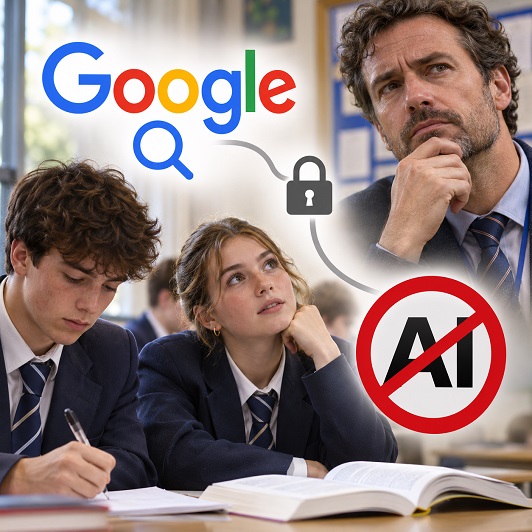
Google’s planned changes to school accounts will leave schools that reject generative AI unable to offer pupils Google Search through those accounts, raising questions about how much control educators retain when familiar services come with features they cannot separately disable.
What Has Google Announced?
Google recently announced (3 November) that Gemini, Gemini Notebook, Gemini in Classroom and Google Search would be switched off by default for K–12 student accounts (the school-managed Google accounts pupils use to access classroom tools and services in primary and secondary education) until school administrators explicitly enabled them.
Google says it is making the changes after listening to educators who want greater control over AI in schools, with the aim of helping to “provide school leaders the control and confidence to use AI products in classrooms as they see fit”.
Soon administrators will be able to enable products individually, so a school can allow Search while keeping the separate Gemini tools disabled. However, it can't offer Search with all its generative AI features removed. A school wanting to exclude those features would therefore have to leave Search unavailable.
This is a planned change, rather than an immediate shutdown, and Google says it will provide further details before rollout so schools have time to prepare.
Why Is Search Part Of The Dispute?
Google Search now includes AI Overviews, which generate summaries, and AI Mode, which provides conversational responses. For schools, enabling Search therefore involves accepting more than a familiar way to find links to websites.
That's important when, for example, a teacher wants pupils to compare sources, check evidence or work through a question themselves. A generated response can provide a ready-made explanation before the pupil has opened any of the underlying material.
It's likely that schools are happy to use AI for some activities while excluding it from others. The difficulty is really that an on-or-off control for Search doesn't let them make that distinction within the service, thereby leaving teachers’ classroom rules dependent on what the product allows.
How Is Google Trying To Support Learning?
Google is expanding Guided Learning to help pupils work through questions instead of simply receiving finished answers. For example, a student asking for help with a physics problem would receive prompts and explanations intended to help them understand how to solve it.
Selected US schools will begin testing this in Search during November, with the feature appearing when Google recognises certain types of homework request. The company says it will use feedback from those schools to improve the experience before making it more widely available.
Guided Learning is also rolling out globally in Google Classroom, where teachers can set activities using their own course materials and see where pupils are struggling. This gives them more influence over how students use AI during a lesson, but schools that want Search without AI-generated answers still lack that option.
What Evidence Supports Google’s Approach?
In support of this new approach, Google's highlighted some encouraging results from a randomised study involving more than 300 University of Tokyo students who spent half a day studying statistics. Students using standard online resources improved their test scores by 5.3 percentage points, while those also given Guided Learning improved by 8.1 points.
That suggests the tool helped students learn during this particular exercise. However, it doesn't indicate whether younger pupils would benefit in the same way, or whether the improvement would last beyond a short study session.
Google also worked with education charity Ark on a four-week pilot in three UK secondary schools. Teachers said Guided Learning answered pupils’ initial questions during independent work, leaving them more time to help those who needed individual attention. This offers a useful example of how the tool might support teaching, although the feedback doesn't establish whether pupils achieved better results over time.
Concerns Remain
While Google’s studies suggest benefits from carefully guided activities, earlier research raised some concerns about the answers children receive through its existing search tools. In July, child-focused non-profit Common Sense Media tested more than 2,600 searches using accounts configured for children and teenagers. It reported unreliable answers, inappropriate advice and AI Mode completing all 180 homework assignments tested.
That assessment took place before the newly announced changes, so it can't tell schools how well the new Search pilot will work. It does, however, seem to help explain why some educators want the option to turn generated answers off while they assess whether the tools are suitable for their pupils.
Could Schools Choose Another Search Engine?
DuckDuckGo is actually offering schools an alternative through a version of its search engine that switches off its AI features and filters AI-generated images where possible. It also provides instructions for setting the service as the default search engine on managed devices.
Schools considering a switch would still need to check that it works with their content filtering, accessibility requirements and device settings. Pupils would also need to keep checking the sources they find, because removing AI-generated answers from the search page does not remove AI-written material from the websites it links to.
What Does This Mean For Your Business?
For UK schools and their IT providers, the first step is really to check Google’s rollout guidance against what teachers want pupils to be able to do. Testing the settings on a managed pupil account would help establish whether they allow the intended classroom activities and enforce the school’s restrictions. Any alternative search service should go through the same checks before it is introduced.
Businesses face a similar challenge as AI becomes part of software staff already use. An organisation might restrict standalone chatbots while employees receive generated answers through an approved search engine or office application. Reviewing those features would help identify where staff need clearer guidance about entering business information and checking answers against their original sources.
Google’s announcement shows why customers need to ask whether AI features can be switched off without losing the service they originally chose. Schools will have more control over which Google products pupils can access, but those wanting Search without generated answers will still have to look elsewhere. For businesses too, the practical value of an AI policy depends on having software settings that allow them to put it into effect.