


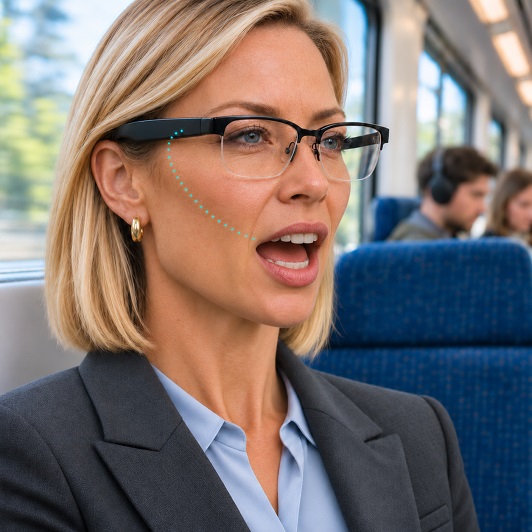
A US startup is developing smart glasses that turn silently mouthed words into text, enabling users to write messages and instruct AI assistants without speaking aloud, although accuracy, comfort and privacy will determine whether the prototypes become useful everyday equipment.
What Is Subvocal Building?
The new smart glasses are made by San Francisco-based Subvocal, which was founded by Georgia Tech computer science students Aarush Yadav and Arnav Kumar and is backed by startup investor Y Combinator. The company's goal with the glasses is to offer dictation in places where talking to a computer would disturb others or reveal something private.
The company has, so far, only demonstrated working prototypes and says they can decode open-ended silent speech at more than 200 words per minute. However, the polished glasses shown on its website represent the intended product, rather than the bulkier development hardware used in demonstrations.
The founders are targeting delivery in the first quarter of 2027. Reported early-bird pricing is US$499, comprising a US$199 deposit and US$300 payable when the glasses ship, although buyers should check current terms before ordering.
How Can Glasses Recognise Silent Words?
According to the founders, the glasses send low-power radio waves through the wearer’s face and measure how those signals change as the tongue, lips and other parts of the mouth move. AI models then interpret those patterns and convert them into text.
The wearer deliberately forms words without producing an audible voice. Subvocal says the movements can be subtle, although someone nearby may still notice them. Its website explains, “Subvocal uses deliberate silent articulation.”
This makes the system different from camera-based lip-reading, because it doesn't need video of the wearer’s face.
Why Did The Founders Choose Radio Signals?
The team initially experimented with electrodes attached to the face to measure electrical activity from muscles. That helped explore the idea, but attaching electrodes whenever someone wanted to dictate would make everyday use inconvenient.
Radio sensing, therefore, offered a possible way to build the equipment into glasses instead. However, getting it to actually work required changes to the electronics and antenna positions, followed by training models to recognise the signals produced by different people.
People’s faces and mouth movements differ, so the glasses need a short setup session to learn how each wearer forms words. Subvocal says Y Combinator partner Dave Lieb only had to read 20 sentences to prepare the prototype for his demonstration.
What Has Actually Been Demonstrated?
Subvocal’s demonstrations show words appearing as the wearer silently mouths them, but they don’t tell us how often the system makes mistakes during everyday use. The company has yet to publish an independently verified accuracy figure in the launch material reviewed.
For someone using the glasses at work, those mistakes could matter more than the advertised speed. For example, producing 200 words per minute would save little time if names, technical terms or instructions needed repeated corrections before the text was ready to use.
Researchers have already shown that silent mouth movements can be recognised in more limited settings. Cornell University’s EchoSpeech project used sound waves to identify 31 commands and sequences of digits in a study with 12 participants. That supports the idea of silent input, but recognising a small set of commands is different from accurately transcribing whatever someone chooses to say. It also uses a different sensing method from Subvocal’s radio signals.
Would Silent Dictation Keep Information Private?
The glasses could help someone write a confidential message on a train without other passengers overhearing it. Keeping the words quiet, however, doesn't tell the user what happens to the information once the device captures it.
Yadav has indicated that the initial service would need internet access, with a version that runs locally planned for after the glasses ship. Businesses would therefore need to check where the signals and resulting text are processed, how long they are stored and whether they are used to train AI models before allowing confidential work through the service.
Yadav has also outlined a free tier with a word allowance and an unlimited option costing approximately US$20 a month. Buyers should check the final service terms, as these plans could affect both the ongoing cost and how they can use the glasses.
What Does This Mean For Your Business?
For staff who find typing slow or cannot comfortably dictate aloud, Subvocal could offer another way to prepare notes, messages and instructions. A useful trial would test the language they actually use, including customer names and specialist terms, and measure how long it takes to produce accurate text after corrections.
That trial should also cover comfort, battery life and whether recognition remains reliable as the wearer moves around. A device that works well during a seated demonstration may be less useful if it needs frequent adjustment or recalibration throughout the working day.
When connecting the glasses to business applications, users should be able to check the text before sending a message or approving an action. This would help prevent a misunderstood word from becoming an incorrect customer email or an instruction that software immediately carries out.
The demonstrations suggest that silent dictation could become a practical alternative to typing, but the finished product still needs to prove itself in ordinary use. For businesses, the real benefit would be helping staff complete work more easily while keeping them in control of both the wording and the information they share.