


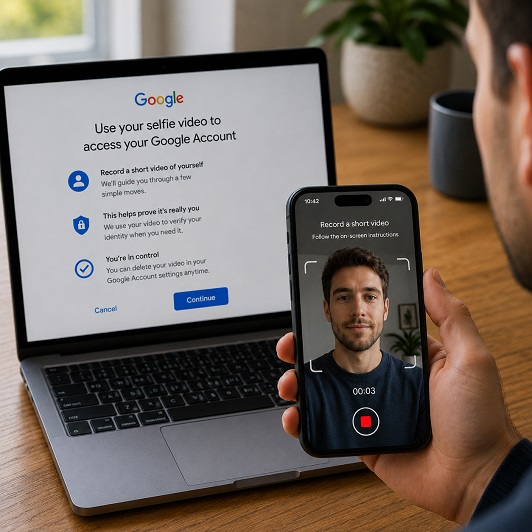
Google has introduced a new way for people to access their Google Account using a short selfie video, giving users another option for recovering their account if they lose access to their usual device while signalling the growing role of facial biometrics in digital identity and online security.
What Has Been Announced?
Google's new feature, called 'Selfie Video', allows eligible users to enrol a short video of themselves as an additional way to sign in to their Google Account.
Rather than replacing passwords, passkeys or other authentication methods, the feature is designed as another recovery option for situations where users are locked out of their account or no longer have access to their usual phone or computer.
As Google explains: "Selfie video is a new way to get into your account, giving you more options if you're ever locked out or don't have access to your usual phone or computer."
Setting up the feature involves recording a short guided video while following a series of simple head movements that allow Google's systems to capture multiple angles of the user's face.
If access to the account is needed later, the user simply records another selfie video, which is compared with the original to confirm their identity.
How Does It Work?
Although the process appears simple, several layers of technology work behind the scenes.
Rather than comparing a still photograph, Google's system analyses a short live video and asks users to perform specific movements while recording. These checks are designed to confirm that a real person is present rather than someone presenting a printed photograph, replayed video or an AI-generated deepfake.
Google says: "When you use a selfie to sign in, we use multiple layers of security to help prevent impersonation attempts like fake photos and videos (i.e., deep fakes)."
The company explains that the system combines comparison against the previously enrolled selfie video with live movement checks and its existing security systems for identifying suspicious sign-in attempts.
The result is intended to provide both convenience and stronger protection against increasingly sophisticated identity fraud.
Privacy Remains Central
Recognising that facial biometrics are particularly sensitive personal data, Google has been very keen to emphasise that users remain in control of their enrolled selfie video.
The video is only created with the user's consent, is encrypted while stored and can be deleted at any time through Google Account settings.
Google also says the video is used solely to help users sign in unless they explicitly choose to allow it to be used for additional purposes.
As the company explains: "Your selfie video is yours and you're in control."
The feature is also unavailable for Google Workspace accounts, children's accounts and users enrolled in Google's Advanced Protection Program, where stricter security measures already apply.
Another Step Towards Passwordless Security
The launch forms part of Google's wider move away from traditional passwords. Over recent years, the company has introduced passkeys, recovery contacts and other authentication methods designed to reduce reliance on passwords that can be stolen, guessed or compromised through phishing attacks.
Selfie Video expands those options by providing another recovery mechanism when users cannot access their existing devices.
Importantly, Google has been careful to distinguish the feature from facial recognition systems used for other purposes.
The company says Selfie Video "isn't designed to be used for age verification", even though similar facial analysis technologies are increasingly being adopted elsewhere for estimating users' ages or confirming identity.
Instead, Google's focus is on making account recovery simpler while maintaining strong protection against impersonation.
A Broader Change In Digital Identity
The introduction of Selfie Video also reflects a wider change taking place across the technology industry. For many years, digital identity depended largely on passwords, security questions and one-time authentication codes. Increasingly, however, authentication is becoming based on something users possess, such as a trusted device, or something they are, such as their fingerprint or face.
Facial biometrics have already become familiar through smartphone face unlock, airport passport gates and online banking identity checks. Google's latest announcement extends that trend into one of the world's most widely used online accounts.
At the same time, advances in AI-generated images and video mean that biometric authentication systems must continually evolve. Technologies such as liveness detection, anti-spoofing systems and behavioural analysis are therefore becoming just as important as facial recognition itself.
Google's emphasis on multiple layers of verification reflects the reality that modern identity protection increasingly relies on combining several independent security checks rather than trusting any single method alone.
What Does This Mean For Your Business?
For businesses, Google's latest announcement reinforces the continuing move towards passwordless authentication and more flexible approaches to digital identity.
Although Selfie Video currently applies only to eligible personal Google Accounts, the underlying technologies are likely to become increasingly common across online services as organisations look for ways to improve both security and user experience. Password recovery remains one of the weakest points in many authentication systems, and biometric recovery methods offer a potentially more secure alternative when implemented with appropriate safeguards.
The announcement also highlights the growing importance of trust when organisations introduce biometric technologies. Giving users clear control over how biometric information is stored, used and deleted will remain essential if businesses are to encourage adoption while meeting privacy expectations and regulatory requirements.
The broader picture is becoming increasingly clear. Digital identity is moving steadily beyond passwords towards a combination of passkeys, trusted devices, biometrics and intelligent risk analysis that work together behind the scenes. Google's latest feature is another step along that path, showing how facial recognition is becoming less about replacing existing security measures and more about providing users with secure, resilient ways to regain access when other methods are unavailable.