


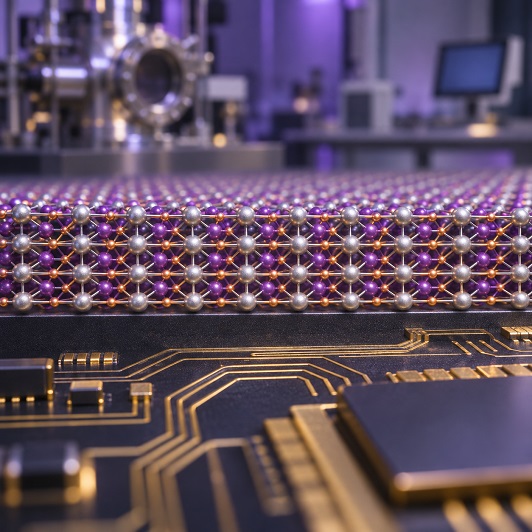
Engineers at Brown University have overcome a materials problem that has held back low-power electronics, potentially opening a route to more energy-efficient AI chips, although working devices and measurable environmental savings still need to follow.
What Have The Researchers Achieved?
The Brown University team (Providence, Rhode Island, in the US) developed exceptionally thin layers of bismuth ferrite that retain their useful electrical and magnetic properties. Their research, published in Nature Materials recently, addresses a problem known as the “dead layer” effect, where those properties disappear as the material becomes thinner.
That has frustrated efforts to use it in microchips, where components must fit into extremely small spaces. The researchers managed to preserve the properties in a film just four unit cells thick, approximately 1.6 nanometres, according to the laboratory’s explanation.
“We've established that we can get rid of the dead layer,” said Lucas Caretta, the Brown assistant professor of engineering who led the work. The result gives researchers a way to investigate useful behaviour at dimensions where it would normally disappear.
How Could This Reduce Energy Use?
Bismuth ferrite belongs to a class of materials called multiferroics, whose electrical and magnetic properties are linked. Applying a small voltage can reverse the arrangement of positive and negative charges within the material.
Those different arrangements could represent the ones and zeros used to store information. Their connection to magnetism also offers a way to read that information, creating possibilities for memory and computing components operated using low-power voltage pulses.
The attraction is therefore the possibility of using less energy to handle information inside electronic devices. However, this research establishes useful material properties rather than demonstrating a finished AI processor with a measured advantage over existing chips.
How Did The Team Keep The Material Working?
The researchers changed the layers surrounding the bismuth ferrite to tackle two problems that emerge when it becomes very thin, i.e., its atomic structure can become unstable, while internal electric fields can disrupt the charge arrangement needed for it to work.
They did so by growing the film on dysprosium scandate, a material with a narrower crystal structure. This squeezes the bismuth ferrite slightly, helping preserve its structure. A metallic layer also screens disruptive electric fields, allowing its electrical properties to survive.
“We know the underlying properties are already there in the bulk materials,” Caretta explained. The challenge was keeping them useful when the material was reduced to dimensions suitable for electronics.
What Changed About Its Magnetism?
As the researchers made the film thinner, they also found signs of a magnetic state known as altermagnetism. This could offer another advantage for chip designers by allowing components to operate quickly and produce readable signals without stray magnetic fields interfering with neighbouring components.
Reducing that interference could make it easier to fit components closer together, helping engineers build smaller, more densely packed chips. However, the team still needs to establish how these properties would perform in working devices, including whether they can reliably store and process information.
Sustainability Benefits
The prospect of doing the same computing work with less electricity is likely to be particularly attractive as AI use grows. In its 2025 Energy and AI report, the International Energy Agency forecast that global data centre electricity consumption would more than double to around 945 terawatt-hours by 2030. That figure covers all data centre activity, with AI expected to be the largest driver of the increase.
More efficient chips could help limit that demand, reducing the amount of additional power needed to support digital services. Brown’s research seems to offer a possible route towards those improvements, although it doesn't yet show how much electricity a finished device would save.
Any environmental assessment would also need to look beyond electricity consumption during use. Producing the materials and manufacturing the chips would have their own impacts, which would need to be weighed against the savings achieved over the equipment’s working life.
What Does This Mean For Your Business?
For UK businesses using AI, the research points to possible improvements in future hardware, but there's no finished product or measured energy saving to build into purchasing decisions just yet. Businesses can still use the questions it raises when assessing efficiency claims about equipment and cloud services available today.
For example, ask suppliers whether their figures cover the complete system and how much energy it uses to carry out work comparable to your own. A saving measured under carefully chosen test conditions may not reflect the way your staff use the service, particularly if tasks require repeated attempts or further processing.
Businesses should also track overall consumption as their use of AI expands. Using less electricity for each task is helpful, but total demand could still rise if the organisation starts carrying out substantially more work through those systems.
This breakthrough could eventually help businesses get more useful work from the electricity they consume. However, the next step is to turn the material into dependable components and demonstrate those savings in practice, giving buyers evidence they can use when comparing both performance and environmental impact.